
Searching Juab County Criminal Dockets
Utah Courts XChange serves as the statewide public index. It covers both District Court and Justice Court case information held in CORIS. Begin with whatever court is named on your citation, summons, notice, or prior order. Felonies and class A misdemeanors point to Fourth District Court in Nephi. Class B or C misdemeanors, infractions, county ordinance matters, and traffic charges usually land in Juab County Justice Court or Nephi City Justice Court, depending on territory. That venue choice is the first real decision in a docket search.
A case number alone can match more than one Utah case. Narrow things by adding Juab County, the court location, the case type, and a date range. When initials vary across filings, a first-name fragment followed by an asterisk helps a name search. A birth date can also thin out a criminal result. Only use one you already know from official case papers. Do not copy or republish it.
- Choose District Court, Justice Court, or both under Jurisdiction.
- Enter a case number, party name, or citation number, then set the search scope to Juab County or the named court.
- Compare the court location, case type, filing date, and case number on each plausible result.
- Open the case number and Case History/Documents links to review public charges, pleas, events, settings, and outcomes.
- Use the correct clerk when an item is missing, older, restricted, or needed as a certified copy.
Another option is MyCourtCase, a free service for parties rather than the general public. It requires an email address, a case number, a court location, and an identity check. So it cannot be used as a name-search tool. Utah eFiling, meanwhile, is built for submitting filings. It is not where you read the public Juab County criminal docket.
Juab Criminal Docket Court Split
Venue drives every search. The Juab County Attorney prosecutes felonies in District Court, misdemeanors in County Justice Court, and juvenile matters in Juvenile Court. That office does not certify docket copies, though. Local Utah court staff keep the case files and enter the public case data you see.
| Court | Criminal docket | Clerk route |
|---|---|---|
| Fourth District Court, Juab/Nephi | Felonies and class A misdemeanors | 160 N Main, Nephi; 435-623-0901 |
| Juab County Justice Court | County class B/C misdemeanors, infractions, ordinance and traffic matters | 160 N Main, Nephi; 435-623-3440 |
| Nephi City Justice Court | Limited-jurisdiction cases within Nephi City | 435-623-1263 |
| Fourth District Juvenile Court | Juvenile delinquency and related matters | 102 E 200 N, Nephi; 435-623-0922 |
Juvenile delinquency cases never appear in public XChange. Access runs through the Juvenile Court under its own separate rules. So a missing public result does not prove that no case exists.
Inside a Juab County Criminal Docket
An expanded XChange case history opens with the court, location, case number, case type, caption, filing date, and assigned judge. From there it ties the people and attorneys to the charge and event data. Utah Courts documents the first two digits of a case number as the filing year. Numbers are not unique statewide, though. Keep the location beside the number every time.
| Charge | The alleged offense, Utah code reference, level, and any listed special attributes. |
|---|---|
| Plea | The dated response, such as guilty, not guilty, or no contest. |
| Settings | Arraignment, pretrial, trial, sentencing, review, or another scheduled event. |
| Case History | Dated filings, minutes, motions, notices, orders, warrants, and compliance entries. |
| Disposition | The recorded result, such as conviction, acquittal, dismissal, or closure. |
| Documents | Available images linked from the event list; an image is not a certified copy. |
| Accounting | Payment data when shown, subject to clerk confirmation. |
The XChange help page is the official explanation of the interface and its field families. It also carries a practical warning. Only 500 results display, so narrow a common name before you run the search.
Read Juab Charges and Outcomes
A charge is an allegation, not an outcome. Read the classification first. Then find the plea and disposition rows. A no-contest plea can support a conviction even without a conventional guilty plea. A dismissal ends the charge or case as the order states, and it does not rewrite earlier public events unless a later expungement or access rule applies.
- Disposition
- The recorded result of a charge or case, such as conviction, dismissal, or acquittal.
- Pretrial conference
- A setting after a not-guilty plea for case discussion and possible trial scheduling.
- Continuance or reset
- A move from one setting date to a later date. The newest valid notice controls.
- Warrant
- A court order that may follow a failure to respond or appear when required.
- Expunged
- A case restricted through a legal process and removed from public XChange.
Utah's public weekly reports sometimes use short disposition codes. No Juab-specific code list is reliable, so do not guess at an unexplained code. Read the full event text instead, or ask the clerk.
How a Criminal Case Moves
The county criminal-case explanation walks through notice by citation, summons, or arrest. Then it covers the court process that follows. At a first appearance or arraignment, the judge explains the charges and rights. The judge also takes a plea there. A not-guilty plea usually leads to a pretrial conference. If the case does not resolve there, it moves to trial.
Filing or citation → Arraignment → Pretrial → Plea or trial → Disposition → Sentencing
Motions and orders can show up between those points. Later entries may cover probation, payment, fingerprints, an appeal, or case closure. When a hearing has moved, the latest docket event matters most. A past arraignment entry is not a future trial date. A reset is not a dismissal.
Note: Confirm any changed setting with the court named on the notice. Do that before relying on an older case-history event.
Juab Criminal Docket Workload
The County Attorney reports annual averages of 200 to 300 District Court cases, 500 to 600 Justice Court cases, and 100 to 200 Juvenile Court cases handled by its three prosecutors. Treat those as prosecution workload ranges, not a tally of total court filings. Civil and probate cases fall outside the figures entirely.
The same official source shows the court-level split behind a Juab County criminal docket search. The public criminal docket role and workload page lists the office's case counts and duties.
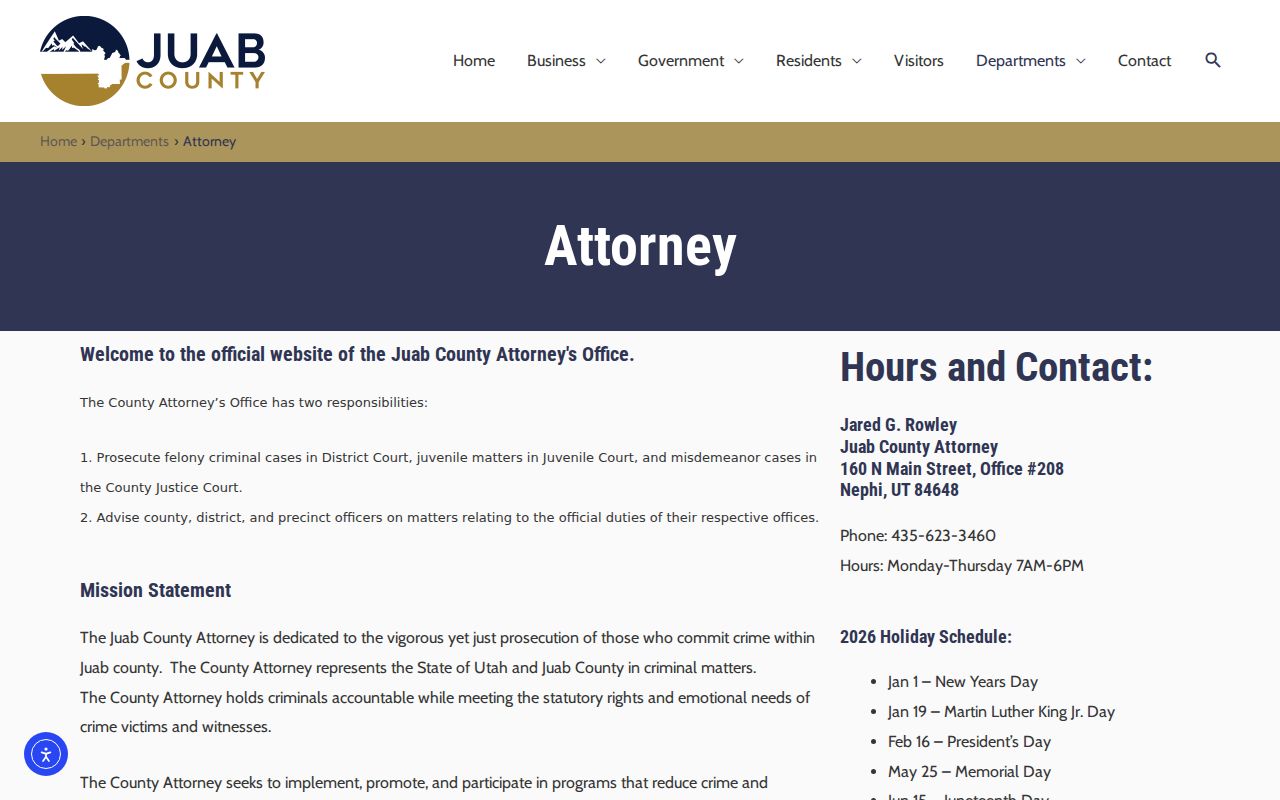
Those figures explain something practical. Choosing District or Justice jurisdiction is a core search step, not a minor filter you can skip.
Courts That Hold Criminal Dockets
Fourth District Court is the court of record for Juab County felony cases and class A misdemeanors. Juab County Justice Court and Nephi City Justice Court are courts of limited jurisdiction. Each holds distinct case histories. All three still work inside the statewide Utah Courts ecosystem.
One judge can serve more than one local Justice Court. Judge Barbara Finlinson currently serves both Juab County and Nephi City Justice Courts. Yet the location shown on the case still controls the file and contact line. Her official Utah Courts biography gives her background and assignments.
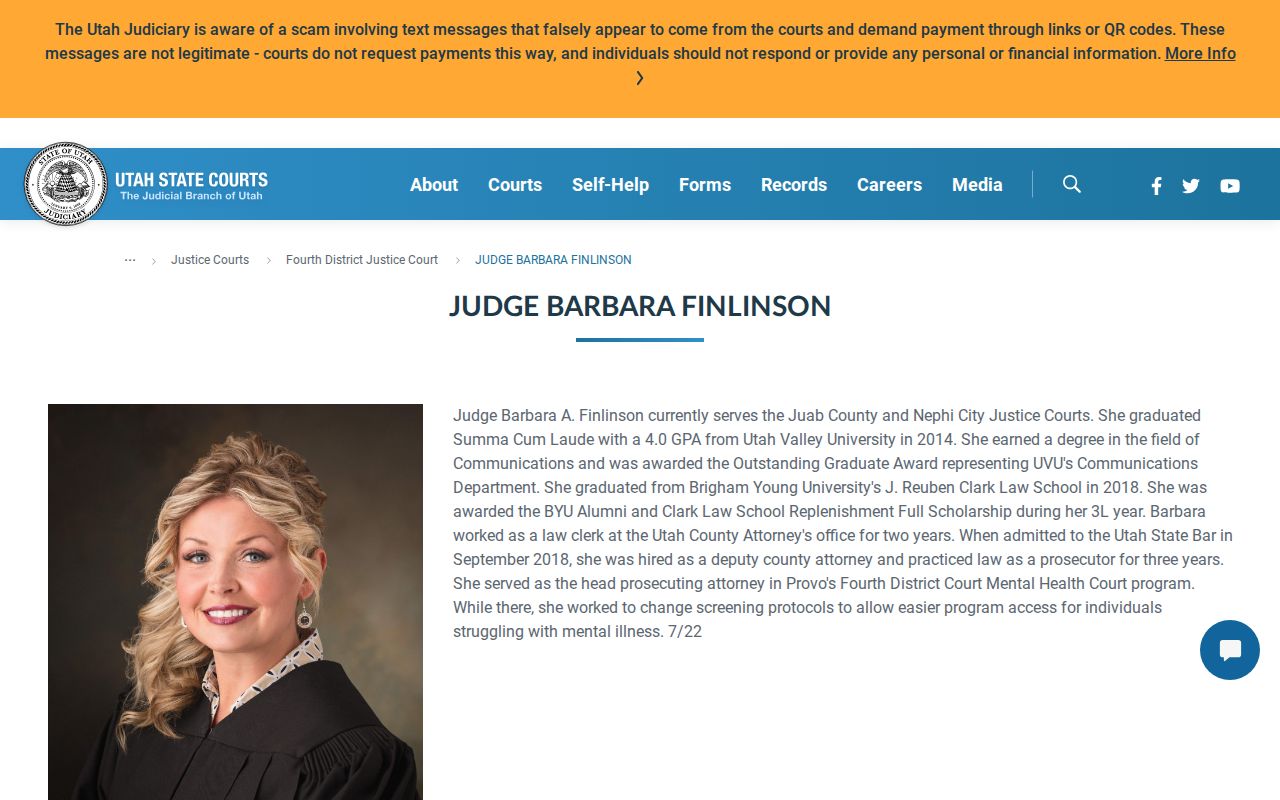
Even though the same judges serve both benches, the Juab County and Nephi City dockets stay separate. Whatever location is printed on your result is the one to search or call.
When a Juab Criminal Case Is Missing
Start with the basics when a Juab criminal docket comes up empty. Check the name spelling, the filing year, and whether you are searching the right court. A new filing may simply not be indexed yet. Cases sometimes belong to Nephi City instead of the county Justice Court. Others sit at the District Court level. Records from older Justice Court years can also be thin. Each Utah Justice Court handled its own CORIS conversion.
If none of that explains it, think about access. Sealed, expunged, and juvenile matters never appear in public XChange. A party to the case can log into MyCourtCase. You will need the exact case number and location. A member of the public can use a free XChange terminal at the courthouse. That person can also mail a specific written request to the right clerk.
Utah Courts publishes the contact route for the Juab courthouse. The Fourth District Juab contact page lists the Nephi location and the court phone.
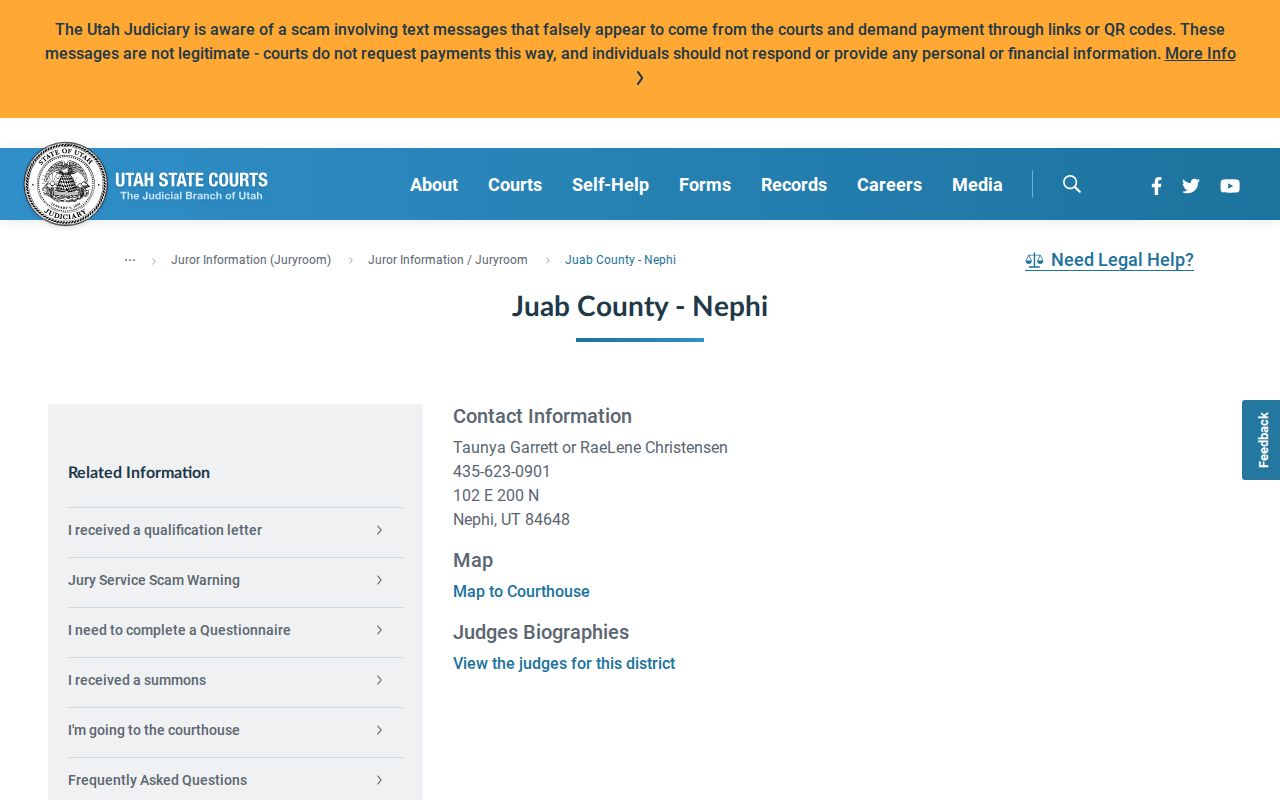
One call usually settles it. Dial 435-623-0901 for the District Court, 435-623-3440 for the Juab County Justice Court, or 435-623-1263 for the Nephi City Justice Court.
Juab Drug Court Docket Entries
Juab County runs an Adult Drug Court program. Judge Jared Eldridge's official biography says he helped establish the Juab County Drug Court in 2003. That work came while serving as County Attorney. Judicial Council material later listed a certified Juab County, Nephi adult drug program.
None of that means a separate public specialty calendar exists. Pull the underlying criminal case number in XChange. Then read the treatment, probation, review, or compliance entries on the public docket. Details about program participation may be private or protected. The clerk or the County Attorney can share current referral information. But neither should be used to guess at facts the public case history does not show.
Note: a specialty-court reference may sit inside the ordinary criminal case history. It may not sit on a stand-alone public docket.
Sealed Dockets and Public Access
Utah court records are presumed public. A rule, statute, or court order can change that. Public criminal case histories can show parties, charges, settings, orders, judgments, and outcomes. Still, public access is not the same as unrestricted access to every filed paper.
Utah access rules:
UCJA Rule 4-202.02 classifies records as public, private, protected, safeguarded, sealed, or otherwise non-public.
UCJA Rule 4-202.03 permits any person to inspect public court records while limiting sealed and expunged access.
UCJA Rule 4-202.04 provides the written request and motion or petition route for disputed access.
Put the essentials in writing when you request a record. Name the court and give your contact details. Also identify the case number plus the exact judgment, order, docket history, or other record you want. The statewide court page says the usual response comes within ten business days. Inspection is free, though copies and staff work may cost money. Certification runs $4 per document plus $0.50 per page under the published Utah fee schedule.