
How to Search Cases by Name
For a search by name, the statewide index is Utah Courts XChange Public Case Search. It pulls public District and Justice Court data from CORIS. Type a last name or company first. Then add a first name, using an asterisk when you only have a fragment or an initial variant. A common name calls for tighter limits. Try a Juab County scope, a court location, a case type, or a date range.
- Choose District Court, Justice Court, or both. District covers felony, class A misdemeanor, general civil, and probate matters; Justice covers traffic, infractions, class B and C misdemeanors, ordinance cases, and small claims.
- Enter Last Name/Company, then First Name if known. Do not publish a birth date shown in a result.
- Select Juab County or a specific Juab County, Nephi City, or Fourth District location.
- Add case type and date range to prevent an overbroad result set, then select Search.
- Compare county, location, case type, filing date, party code, and number before opening Case History/Documents.
| Field | Type | Required | Juab search note |
|---|---|---|---|
| Jurisdiction | Dropdown | Unspecified | District Court, Justice Court, or both |
| Last Name / Company | Text | Optional | Business names belong here |
| First Name | Text | Optional | Asterisk supports variants |
| Case Type | Dropdown | Optional | Narrow criminal, civil, traffic, probate, or small claims |
| Search Scope | Dropdown | Optional | Select Juab County or one court |
| Date Range | Date fields | Optional | Open the date-range panel |
XChange help says selecting Search can count as a billable search. Narrow first.
Juab XChange Scope Controls
Scope controls keep a plausible name match from pointing at the wrong Juab County case. Fourth District Court in Nephi keeps the general-jurisdiction record. The limited-jurisdiction courts, Juab County Justice Court and Nephi City Justice Court, are separate locations. Someone with a Nephi address may show up in any of them. The official XChange search form displays the public controls.
Those court and county filters are part of the identity check, not just a convenience.
Narrow before searching. XChange may return no more than 500 results, so a surname-only statewide search can hide the useful match inside an oversized result set.
Citations work the same way. Pair the citation number with its location, because citation numbers are not unique statewide either. If the paper names Nephi City Justice Court, search there even after a county Justice search comes up empty.
How to Search by Case Number
A case number is the sharpest starting field, but it is not a statewide key. Utah's own XChange help notes that the first two digits mark the filing year. So 24-000123 signals a 2024 filing, yet Juab County users should assume nothing beyond that. Type the full number from your notice and add the court location. No result? Remove stray spaces or punctuation as the interface allows. Double-check the year. Then try the other court level. Some older Justice Court records look thin. Each court made its own CORIS conversion choices. Your own case works differently. The same number and exact location can link to a MyCourtCase account. It asks for an email address and a government-issued ID at registration. Linking often fails because of a wrong location or a name mismatch.
Why Juab Numbers Need Locations
Utah case numbers and citation numbers are not unique across courts. Every number must travel with its jurisdiction and court location. In Juab County this matters a great deal. The District Court, the county Justice Court, and Nephi City Justice Court each keep separate dockets. Searching one docket with a bare number can miss the case entirely.
| Fourth District Court | Felony, class A misdemeanor, general civil, probate, and other District Court cases. |
|---|---|
| Juab County Justice Court | County traffic, infractions, ordinance matters, class B and C misdemeanors, and small claims. |
| Nephi City Justice Court | Limited-jurisdiction cases arising within Nephi City authority. |
| Fourth District Juvenile Court | Juvenile matters, which are not public XChange results. |
Levan Justice Court no longer exists. It was dissolved effective April 1, 2021, and its cases moved to Juab County Justice Court. Old papers that name Levan should go through the current county clerk, not a live portal.
What a Case Search Shows
A search result row is only an index. Click through and the case opens into an expanded case history where public information exists. Utah labels this the case history, case information, or documents view. Always read the header before relying on any single event.
| Case Number | The court identifier, read with location and case type. |
|---|---|
| Caption / Style | The public case title and named party roles. |
| Case Type | Criminal, civil, traffic, small claims, probate, or another classification. |
| Filed Date | The date the case entered that court. |
| Judge and Attorneys | Assignments entered in the public record. |
| Case History | Dated filings, hearings, minute entries, orders, judgments, and outcomes. |
| Documents | Images available through XChange when public and electronically accessible. |
| Accounting | Payment data when displayed; confirm certified balances with the clerk. |
District Court documents filed electronically since July 1, 2010 can generally be purchased through XChange. Keep in mind the public index is not a certified court record. For a certified copy, ask the clerk.
Juab Party Codes Decoded
Party codes describe a person's role, and only that. They are not case outcomes. One person can hold more than one role across different matters.
- PLA / DEF
- Plaintiff starts a civil claim; defendant answers it or is accused in a criminal case.
- PET / RES
- Petitioner asks for an order; respondent answers the petition.
- INT
- An intervenor enters an existing case under court rules.
- GAL
- A guardian ad litem represents an interest assigned by the court.
- GAR
- A garnishee holds property or funds addressed by garnishment process.
- DEC / HER / CON
- Decedent, heir, and conservator are roles that may appear in probate-related records.
The official XChange help explains result columns, case history, and public document access.
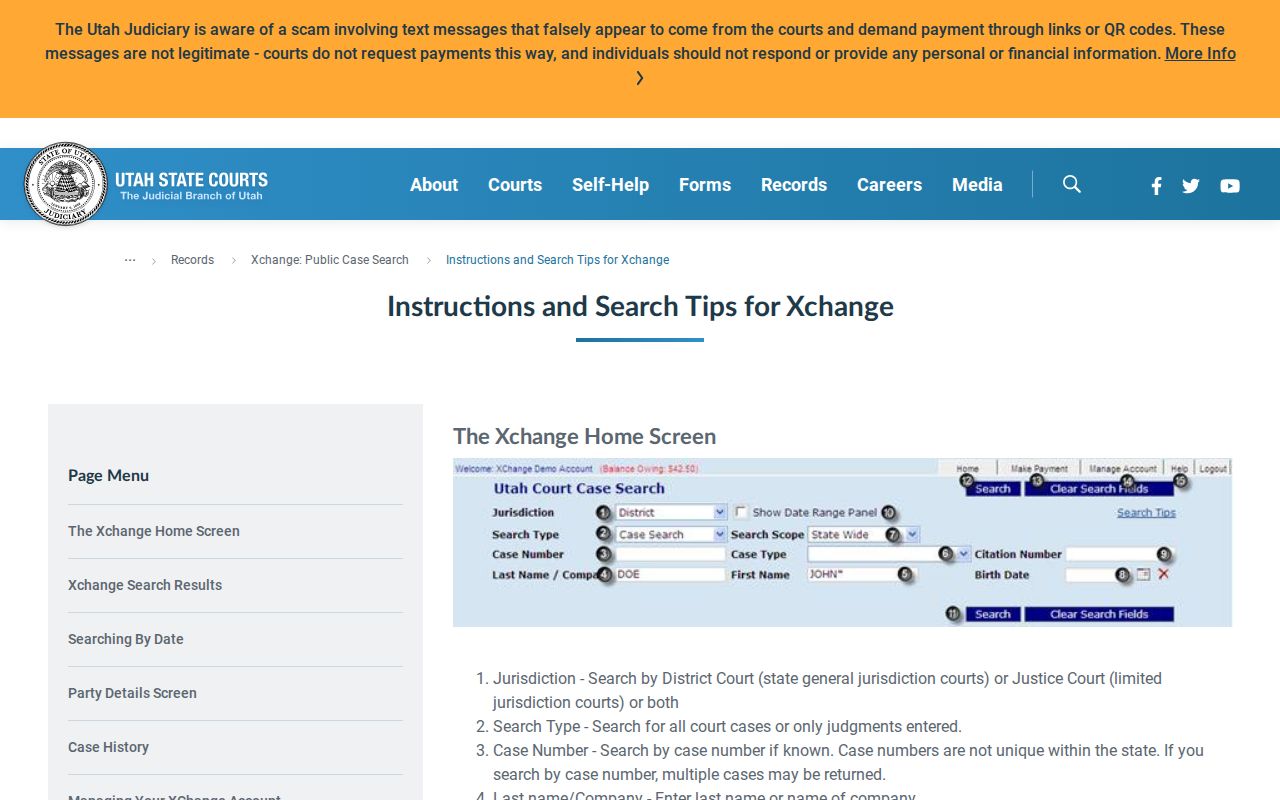
That field guide helps separate a named party from an attorney, judge, or other listed participant.
County vs Statewide Case Search
Juab County offers no separate public name-search database that replaces XChange. The statewide docket becomes local once you apply the county, jurisdiction, and court-location filters. Beyond that, county-level access still runs through the clerk, a courthouse terminal, and written record requests.
| Channel | Best for | Access or limit |
|---|---|---|
| XChange | Public name, number, citation, and case-history search | Guest or subscription; some document images cost money |
| MyCourtCase | A party's own history, notices, documents, filings, and payments | Free, with case number and identity verification |
| eFiling | Submitting eligible filings | Not the public case-history search |
| Courthouse terminal | Free public XChange access | Visit a court location or State Law Library |
| Clerk request | Older, archived, unavailable, or certified material | In person, phone coordination, mail, or written request |
The XChange scope page describes statewide coverage and exclusions.
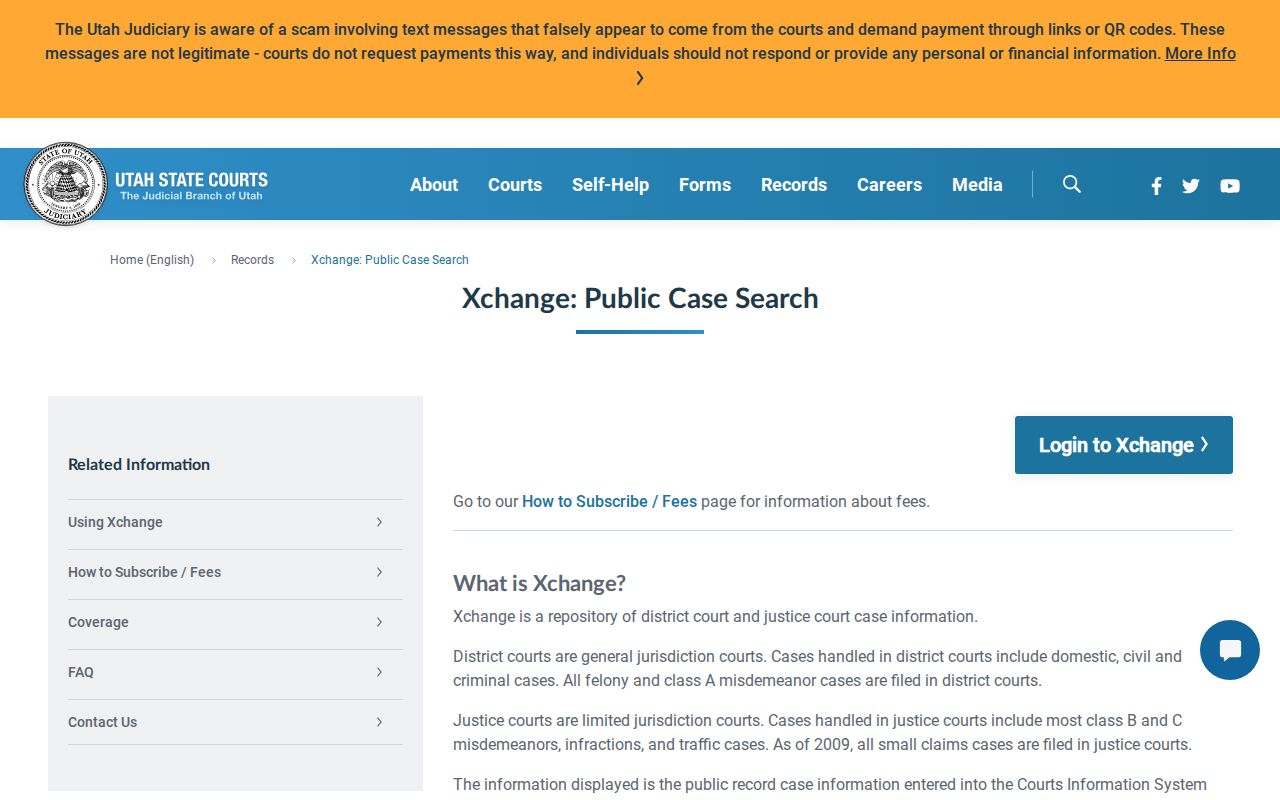
It confirms why search coverage and document availability are related but not the same thing.
Free Juab Search Alternatives
A paid web account is not the only way in. Utah Courts places free public XChange terminals at most District Court locations. Possibly some Justice Court spots have them, and the State Law Library does too. For Juab County District or county Justice matters, the shared courthouse address is 160 N Main Street. It sits in Nephi. Call ahead to confirm terminal access and hours. Fourth District Court answers at 435-623-0901. Juab County Justice Court uses 435-623-3440. It posts Monday through Thursday hours of 8:30 a.m. to 5 p.m., with Friday hours of 8:30 a.m. to 2:30 p.m. Nephi City Justice Court can be reached at 435-623-1263. The XChange landing screen lays out both guest and account routes.
When an image will not load, an archived file is missing, or you need a certified copy, send a written request to the clerk under Utah court-record rules.
Case History Versus Document Image
Think of the docket as two layers. The case history is the public index. It moves in date order through filings, hearings, orders, judgments, dispositions, and accounting events. Behind each entry sits a document image, the actual filed paper. Some events have no public image at all. Some public cases never post every page online.
XChange charges $1 per document for image access. That copy is not clerk-certified, though. If you need certification or plan to file the record somewhere else, ask Fourth District Court staff. The right Justice Court clerk can help too. Utah's current fee page puts certified copies at $4 per document plus $0.50 per page.
Monday brings fresh District Court CSV reports, except on holidays. They cover only public records, so they supplement rather than replace a case history. The Fourth District judgment archive spans the whole district, so its locations reach beyond Juab.
Restricted Cases and Access Rules
Public XChange leaves out sealed, expunged, juvenile, and other non-public cases. Utah draws a line between sealed records and private or protected ones. A sealed file is physically closed. Even a party needs a court order to open it. Private or protected information goes only to people a rule authorizes.
Rule 4-202.02 sorts court records into classes, while Rule 4-202.03 decides who may see them. An empty result screen proves nothing. The name, court, or date filter may be off. The filing may be new, an older record may not have been fully converted, or access may simply be restricted.
When a public record is missing online, file the official Request for a Court Record with the right clerk. Give contact information and enough case detail to pinpoint the item. Rule 4-202.04 sets out the written-request and review route. Never try to slip past a restriction with a wider name search.
Note: Public case lookup is for locating court information. It is not for judging another person's eligibility for a private benefit.